



What If Atlantis Wasn't Lost Beneath the Waves but Rather Transformed into a Parallel Reality?

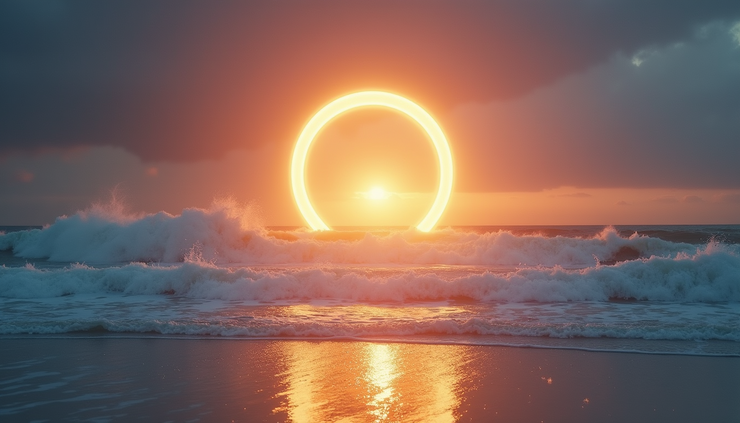
You probably picture Atlantis the way most people do—stone pillars, drowned streets, a tragic city crushed beneath an angry sea. A cautionary myth. A bedtime story for philosophers. That image is small. Atlantis, if it ever mattered at all, was never just a place. It was a state of coherence. What if Atlantis didn’t sink—what if it shifted? Not down, but sideways. Across the grain of reality.
This idea challenges everything we think we know about Atlantis. Instead of a sunken city lost to history, imagine Atlantis as a civilization that slipped into a parallel reality, a different dimension running alongside our own. This post explores that possibility, what it means for our understanding of history, and how it might change the way we view myths and reality itself.

The Traditional View of Atlantis
Most stories about Atlantis come from Plato’s dialogues, where he describes a powerful island nation that sank into the ocean in a single day and night. Since then, Atlantis has been a symbol of lost knowledge, advanced technology, and a warning against hubris. The image is always the same: a city swallowed by the sea, buried under layers of sediment and water.
Archaeologists and historians have searched for Atlantis in the Mediterranean, the Atlantic Ocean, and even Antarctica. None has found definitive proof. This lack of evidence has led many to dismiss Atlantis as a myth or allegory. But what if the problem lies in the assumption that Atlantis sank downward into the ocean?
Shifting Reality Instead of Sinking
The idea that Atlantis shifted sideways into a parallel reality suggests a different kind of disappearance. Instead of being physically destroyed or buried, the city and its people moved into a different dimension or plane of existence. This shift would explain why no physical evidence remains in our world.
Parallel realities or alternate dimensions are concepts explored in physics and philosophy. Quantum mechanics, for example, suggests the existence of multiple universes where different versions of reality coexist. If Atlantis transitioned into one of these realities, it might still exist, but out of reach for our current perception and technology.
This theory reframes Atlantis not as a lost city but as a civilization that achieved a form of coherence or harmony with the universe, allowing it to move beyond our physical plane.
What Would a Parallel Atlantis Look Like?
If Atlantis exists in a parallel reality, what might it be like? Here are some possibilities:
Advanced Technology and Knowledge
Atlantis might have developed technologies beyond our understanding, including ways to manipulate space and time. This could have enabled their shift into another reality.
Different Physical Laws
The parallel reality might have different physical or metaphysical laws, allowing for phenomena impossible in our world. This could explain the myths of Atlantean magic or supernatural abilities.
A Society in Harmony
The state of coherence mentioned earlier could mean a society that achieved perfect balance between nature, technology, and spirituality. This harmony might be the key to their dimensional shift.
Invisible to Us
From our perspective, Atlantis would be invisible or intangible, like a ghost city existing alongside our own world but out of phase with it.

Implications for History and Myth
If Atlantis shifted into a parallel reality, it changes how we interpret myths and history:
Myths as Memories of Other Realities
Stories about Atlantis might be echoes of a civilization that still exists but in a different dimension. Myths could be distorted memories or glimpses of that other reality.
Lost Knowledge May Still Exist
The advanced knowledge attributed to Atlantis might not be lost but hidden in another reality. This raises questions about how we might access or rediscover it.
Reevaluating Other Legends
Other myths about lost lands or vanished civilizations might also involve shifts into parallel realities rather than physical destruction.
New Approach to Archaeology and Science
Researchers might need to consider non-physical explanations for missing civilizations, expanding the scope of inquiry beyond traditional methods.
How Could We Detect a Shifted Atlantis?
Detecting a parallel Atlantis would require new ways of thinking and technology:
Quantum and Multidimensional Research
Advances in quantum physics and multidimensional studies might provide clues or tools to detect shifts between realities.
Unexplained Phenomena
Some unexplained natural or paranormal phenomena could be interactions between our reality and a parallel one in which Atlantis exists.
Meditative or Consciousness Exploration
Some theories suggest that altered states of consciousness or deep meditation might allow access to other dimensions, potentially revealing Atlantis.
Technological Innovation
Future technology might enable us to perceive or even travel between realities, opening the door to the discovery of parallel civilizations.
What This Means for Us Today
The idea of Atlantis as a parallel reality invites us to rethink our place in the universe. It encourages curiosity about the unknown and humility about what we do not yet understand. It also suggests that human potential might be far greater than we imagine.
This perspective can inspire:
Exploration Beyond Physical Limits
Encouraging scientific and philosophical exploration into dimensions beyond the physical world.
Respect for Ancient Wisdom
Recognizing that ancient myths might contain truths about realities beyond our current understanding.
Openness to New Ideas
Being open to unconventional explanations for history and existence.
Personal Growth
Considering how states of coherence and harmony might transform individual and collective consciousness.
The story of Atlantis might not be about loss but transformation. It might be a call to expand our vision and embrace the mysteries that lie beyond the visible world.


Comments